This article contains affiliate links. If you buy through them, we may earn a commission at no extra cost to you. Learn more.
Buyer's Guide
Before you buy IPTV subscription services, you need to know which providers are reliable, what equipment works, and how to avoid scams. Here's the checklist that matters.
In Brief
- Most IPTV regrets come from skipping the trial — a 24-hour free test reveals buffering and channel quality before you pay.
- Device compatibility matters more than channel count: Firestick, Android TV, and Samsung/LG apps cover most households.
- PayPal or card payment gives you a practical refund route; crypto-only sellers leave you with no protection.
- The cheapest monthly plan is rarely the best value once you factor in downtime, EPG quality, and support.
Choosing to buy IPTV subscription services can feel like stepping into an unregulated marketplace. Some sellers deliver a polished 4K interface with 20,000 channels; others disappear after the first payment. The difference usually comes down to a handful of verifiable details — server capacity, device compatibility, payment protection, and trial policy — that you can check in about ten minutes. This guide walks you through those checks so you can make a decision based on evidence rather than marketing.
IPTV, or Internet Protocol Television, delivers live TV and on-demand content over your broadband connection rather than through a cable or satellite feed. That distinction matters because your internet quality — not the provider's marketing — determines most of your viewing experience. A service that works flawlessly on a 100 Mbps fiber connection may buffer constantly on 20 Mbps DSL. The best providers know this and offer a trial so you can test on your own network.
Why Many People Regret Their Choice
Every month, thousands of people search for a new IPTV provider after a bad experience with a previous one. The pattern is remarkably consistent. They pay for a year in advance because the per-month price drops from $15 to $8. The first week is great. Then the channel list starts shrinking, the EPG stops loading, and the provider's Telegram account goes silent. By the time the service dies completely, the chargeback window has closed.
The regret is rarely about buying IPTV itself. It's about buying from the wrong kind of seller. IPTV operates in a legal gray area in many countries, which means there is no consumer protection agency to complain to. The only real protection is your own due diligence before you hand over money.
This is not to say every IPTV provider is a scam. There are established services that have operated for years, with thousands of customers and consistent quality. The challenge is telling them apart from the sellers who set up a cheap panel, sell 500 subscriptions, and shut down after three months.
Criteria That Should Drive Your Decision
Before you compare channel counts and prices, build a short list of non-negotiable criteria. These four will eliminate most unreliable options.
Free Trial Policy
A provider that refuses a 24-hour free trial is telling you exactly how confident it is in its own service. The trial is not just about channel selection — it's a real-world test of buffering, EPG accuracy, and whether the service works on your specific device. Reputable sellers offer trials because they know their service holds up. Some offer 6-hour trials, which are too short to test evening congestion. Look for 24 hours or more.
Payment Protection
PayPal remains the most common protected payment method in the IPTV world. When a provider accepts PayPal, it has passed a basic vetting process and you have a practical dispute route if the service fails. Credit cards offer similar protection. Crypto-only sellers remove that safety net entirely. If a seller insists on cryptocurrency and offers no alternative, treat it as a warning sign.
Device Compatibility
Not every IPTV service works on every device. Firestick and Android TV boxes are the most widely supported, but Samsung and LG smart TVs require specific apps that not all providers offer. If you want to watch on an iPhone, check for a dedicated iOS app or a compatible player like IPTVX or GSE Smart IPTV. The provider should publish a clear device list. If it doesn't, ask before paying.
Server Capacity
Buffering is the number one complaint in IPTV reviews. Most buffering is caused by overloaded servers, not your internet connection. Ask the provider about server locations and whether they operate their own infrastructure. Some providers publish server status pages. The good ones are transparent about maintenance windows and known issues.
What You Need to Know About the Current Market
The IPTV market in 2026 is more fragmented than ever. At the top end, premium providers sell 4K packages with 20,000-plus channels, catch-up TV, and multi-device support for $15-$25 per month. In the middle, budget services offer 8,000-12,000 channels for $8-$12. At the bottom, sellers on Telegram and Reddit offer "lifetime" subscriptions for $30 — and most of them disappear within six months.
One significant trend is the rise of legal IPTV services. Platforms like YouTube TV, Hulu Live, and Sling TV have improved their sports and international offerings, but they remain two to three times more expensive than unregulated IPTV. For cord-cutters who want specific sports packages or international channels that legal services don't carry, the gray-market option remains attractive.
The legal situation varies by country. In the US and UK, buying IPTV is not itself a criminal offense in most cases, but the legal risk sits with the reseller who redistributes copyrighted content. That said, some rightsholders have targeted individual subscribers in civil cases. It's a risk you should understand before you buy. And if you're specifically looking to buy adult IPTV subscription services, the same checks apply — but privacy considerations become more important, so a VPN is strongly advised.
Another development is the growing number of providers that sell M3U playlists directly. An M3U playlist is essentially a text file with channel links that you load into a player app like TiviMate, IPTV Smarters, or VLC. This gives you more control over the interface, but it also places more responsibility on you to configure the player correctly.
Questions to Ask Before You Buy IPTV Subscription
Before you commit, ask these seven questions. The answers will tell you more than any marketing page.
- Can I have a free trial of 24 hours? If the answer is no, move on.
- Do you accept PayPal or credit cards? Protected payment methods only.
- Which devices do you officially support? Get a specific list, not a vague "all devices."
- How many simultaneous connections are included? One connection is standard; two or three are worth paying a little extra for.
- Where are your servers located? Servers in your region mean lower latency and less buffering.
- Is the EPG included for all channels? A working program guide makes the service usable; many providers only include EPG for major channels.
- What happens if the service goes down? Look for a provider that extends subscriptions for downtime.
The Trial Test
When you get the trial, don't just flip through channels. Test the specific things you care about. If you're buying for sports, find a live match and watch for buffering during peak times. If you're buying for international news, check whether the channels load quickly. Test the EPG by scrolling through tomorrow's listings. Check whether 4K channels actually stream in 4K — some providers label HD channels as 4K.
A provider that refuses a 24-hour free trial is telling you exactly how confident it is in its own service.
Warning Signs to Spot
Some red flags are obvious. Others are subtle. Here's what should make you walk away.
- "Lifetime subscriptions." No IPTV provider can guarantee lifetime service. The cost of running servers rises, content deals change, and legal pressure increases. A lifetime price is a sign that the seller plans to take your money and vanish.
- Crypto-only payment. Cryptocurrency is irreversible. If a provider only accepts crypto, you have no recourse.
- No trial. The single biggest red flag. There is no legitimate reason to refuse a trial.
- Unrealistic channel counts. 50,000 channels is not a selling point. No one watches 50,000 channels, and the number is usually inflated with dead streams.
- Pressure to buy now. Legitimate providers don't use countdown timers. Scammers do.
- No physical address or company registration. Most IPTV sellers operate as individuals, but the established ones typically share a business name and contact details.
| Pros | Cons |
|---|---|
| Lower cost than cable or satellite | Legal gray area in many markets |
| Works on Firestick, Android TV, smart TVs | Service can vanish without notice |
| Huge international channel selection | Requires stable internet (25 Mbps+ for 4K) |
| Flexible monthly plans, no contracts | No official app store presence |

Comparing Available Options
Here's how typical IPTV offerings compare across the features that matter. Use this as a reference, not a scorecard — the specifics vary by provider.
| Feature | Budget Plan | Standard Plan | Premium 4K Plan |
|---|---|---|---|
| Typical price/month | $8-$12 | $12-$18 | $18-$25 |
| Channel count | 8,000-12,000 | 12,000-20,000 | 15,000-25,000 |
| Stream quality | HD, occasional buffering | FHD, stable | 4K/FHD, prioritized servers |
| Devices | Firestick, Android | Firestick, Android, Smart TV | All major platforms |
| Payment options | Card, crypto | PayPal, card | PayPal, card, crypto |
| Free trial | 6-12 hours | 24 hours | 24-48 hours |
| EPG | Major channels only | Full EPG | Full EPG + catch-up |
| Support | Telegram only | Telegram + email | Dedicated support |
One thing to note: the cheapest plan is not a "bad" plan if your needs are basic. If you only want a handful of international channels on a single Firestick, a budget plan may be perfectly adequate. The problem comes when budget plans are sold with premium promises.
Where to Buy
See the current price, available plans, and payment options on the official page.
Recommendations by Budget and Needs
For Firestick Users
Firestick is the default device for IPTV because it's cheap, powerful enough, and supports most provider apps. If you're looking for the best IPTV subscription for Firestick, check that the provider offers a native app or a compatible APK. TiviMate and IPTV Smarters are the two most common players, and both work well on Firestick.
For Sports Fans
Sports is the most common reason people buy IPTV. Look for an affordable IPTV subscription for sports that specifically lists the packages you want — Premier League, NFL, NBA, UFC, cricket — and check whether they include multi-language commentary. A provider that doesn't know what sports channels they carry is a provider that won't deliver them.
For Smart TV Owners
Samsung and LG owners have fewer options because these platforms restrict third-party apps. If you want an IPTV subscription for smart TV Samsung devices, confirm the app situation before buying. Some providers offer native Samsung/LG apps, but most rely on DLNA or screen mirroring. You may need to buy a Firestick or Android box as a workaround.
For Budget Buyers
If you're on a tight budget, the smart move is to buy monthly, not yearly. A monthly IPTV subscription in the USA costs more per month, but it limits your exposure if the provider disappears. The best budget providers offer a 24-hour trial and PayPal payment — use both. For readers in the UK, the same logic applies: a cheap IPTV subscription in the UK should still include a trial and protected payment.
How to Maximize Your Investment
Once you've chosen a provider, there are several ways to get more value from your subscription.
- Use a wired connection or 5 GHz Wi-Fi for 4K streams. Ethernet is always better than Wi-Fi for IPTV. If you can't wire your device, make sure it's on the 5 GHz band, not the congested 2.4 GHz band.
- Set up a VPN. A VPN can help with ISP throttling and adds privacy. Choose a VPN with a dedicated app for your device — ExpressVPN, NordVPN, and Proton VPN all work well with IPTV. The VPN will add a small amount of latency, so choose a server close to your location.
- Configure the EPG properly. Most IPTV players let you load EPG data from a URL. Make sure the correct EPG source is set in your player settings, or the guide will be empty.
- Test channels during peak hours. The best time to test is 7-10 PM on a weekend. If the service holds up then, it will hold up most of the time.
- Keep a backup playlist. Some providers offer a backup M3U URL. Ask for it and store it somewhere safe. If the main server goes down, you can switch to the backup in seconds.
- Use catch-up and VOD features. Most premium plans include catch-up TV (7 days) and a video-on-demand library. These features are often underused but add significant value.
If you're ready to compare options, check the current plans on the official page and use the checklist above to evaluate what you see.
Frequently Asked Questions
Can I buy IPTV subscription with PayPal?
Yes, many IPTV providers accept PayPal, and it's the safest payment method for this type of service. PayPal offers buyer protection that can help you get a refund if the service stops working within the covered period. Before paying, confirm that the provider's PayPal account is verified and check whether they add a surcharge for PayPal payments. Some providers only accept PayPal for the first payment and require crypto for renewals — avoid those.
What is the best IPTV subscription for Firestick?
The best IPTV subscription for Firestick is one that offers a native app or a compatible APK, a 24-hour free trial, and PayPal payment. The Firestick runs Android, so most IPTV apps work on it, but the quality of the app matters. TiviMate and IPTV Smarters are the most popular players, and both are available for Firestick. Look for a provider that specifically mentions Firestick support and provides installation instructions.
Is there an affordable IPTV subscription for sports?
Yes, sports-focused IPTV plans typically cost between $10 and $15 per month and include premium sports channels like ESPN, Sky Sports, beIN Sports, and DAZN. The key is to verify that the provider carries the specific sports you watch. A 24-hour trial is especially important for sports because live events are the most demanding streams — if a provider can't deliver a stable live match, it's not worth your money.
What does a premium IPTV subscription 4K include?
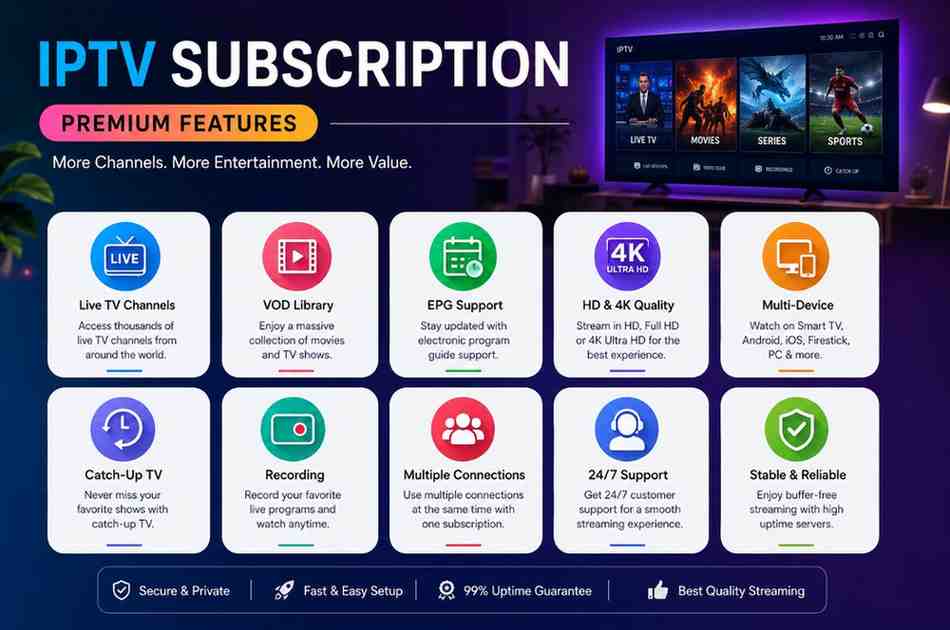
A premium 4K IPTV subscription typically includes 15,000-25,000 channels, 4K and FHD streams, full EPG data, catch-up TV, video-on-demand, and support for multiple devices. The price is usually $18-$25 per month. Premium providers also tend to have better server infrastructure, which means less buffering. However, "4K" is often used loosely in the IPTV market, so test 4K channels during your trial.
How much does a monthly IPTV subscription in the USA cost?
In the USA, a monthly IPTV subscription typically costs between $10 and $25, depending on the channel count and stream quality. Budget plans start around $8-$12 for HD streams and basic channel lists, while premium plans with 4K, full EPG, and multi-device support cost $18-$25. Annual plans reduce the monthly cost by 30-50%, but they carry more risk if the provider disappears. Most US buyers use PayPal or credit cards for protection.
Does a free trial of 24 hours really work for IPTV?
Yes, a 24-hour free trial is the most reliable way to test an IPTV service before committing. It gives you enough time to test live channels, on-demand content, EPG accuracy, and buffering during peak hours. Some providers offer shorter trials of 6-12 hours, which are less useful because they don't cover peak evening hours. If a provider refuses a trial entirely, that's a strong sign of poor service.
Can I buy an M3U playlist subscription for my own player?
Yes, many IPTV providers sell M3U playlist subscriptions that you can load into your own player app such as TiviMate, IPTV Smarters, VLC, or GSE Smart IPTV. An M3U playlist is a text file containing channel URLs and metadata. This is a good option if you prefer a specific player interface. Just make sure the provider offers a stable M3U URL and includes EPG data in the playlist.
Is a worldwide IPTV subscription without buffering realistic?
Worldwide IPTV without buffering is achievable but depends on three factors: your internet speed, the provider's server infrastructure, and your device. You'll want at least 25 Mbps for HD and 50 Mbps for 4K. The provider should have servers distributed globally or in your region. Even then, occasional buffering during major live events is normal. A provider that guarantees "zero buffering" is exaggerating — test it yourself during your trial.
The Bottom Line
Buying IPTV can be a great value if you treat it like a purchase that requires research, not a casual transaction. Test the trial, use PayPal, and buy monthly at first — the right provider will earn your annual commitment.
Get Access NowThis link goes to the seller's official checkout. If you purchase through it, we may earn a commission at no additional cost to you. Our assessment is written independently of that arrangement.
Disclosure: Some links in this article are affiliate links, meaning we may earn a commission if you make a purchase — at no additional cost to you. This does not influence our editorial assessment, which is based on publicly available information about the product.